Remotes, flip keys and smart keys we set up
A key fob is any car key with buttons or a radio inside. Three kinds come up most: a remote that works the door locks from across the lot, a flip key whose blade folds away like a pocketknife, and a push-to-start smart key that can stay in a pocket or purse.
When a fob is lost, cracked past saving or dead for good, key fob replacement means we bring a new one and teach the car to accept it. The car can be beside a barn in Wellington's equestrian area, in a condo garage in Boca Raton, a lot off Indiantown Road in Jupiter or anywhere else in Palm Beach County.
How key fob programming works inside the car
Most fobs hold two separate electronic parts. The chip, or transponder, carries a code the car's immobilizer must accept before the engine will run; the immobilizer is the anti-theft lock in the car's computer. The remote is a small radio transmitter for the locks and, on some cars, the trunk.
Many vehicles pair those two parts in separate steps. So a key may start the engine while its buttons are dead, or open the doors while the engine stays quiet. On a turn-key car whose key has no buttons, transponder key programming deals only with the chip in the key head.
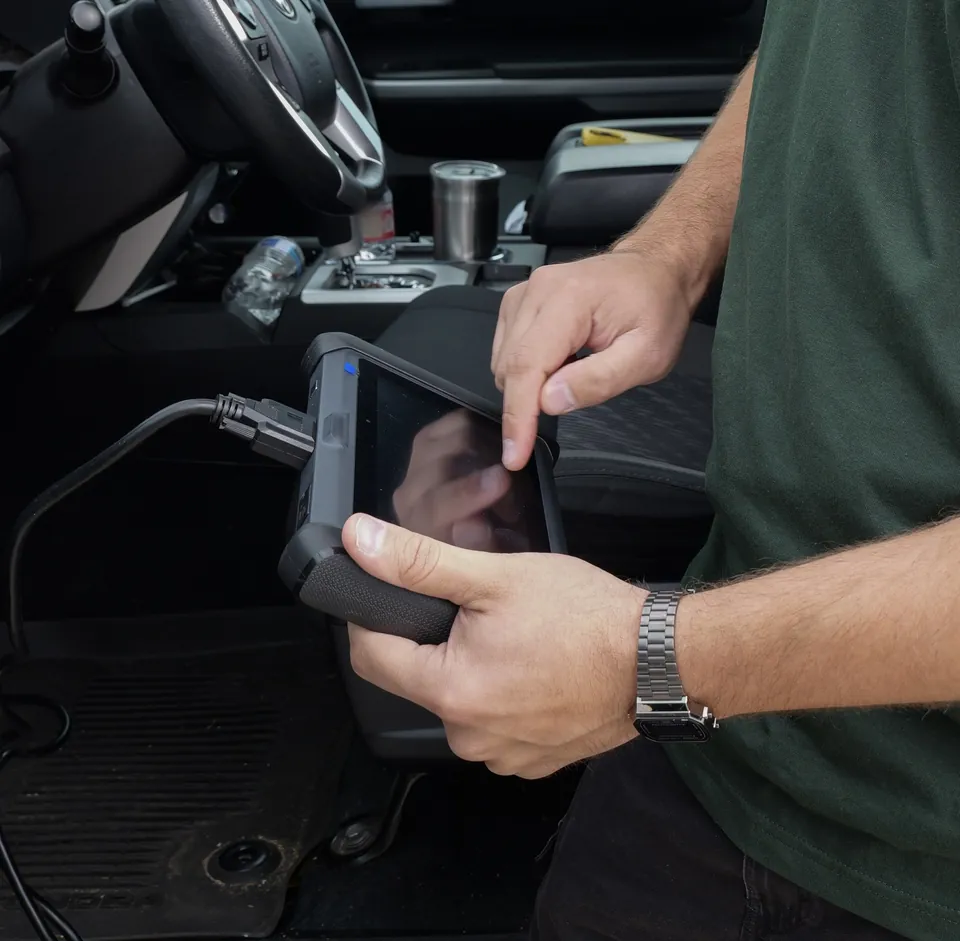
A smart key goes further. It talks to the car by radio, and the start button works only when the car senses a key it knows inside the cabin. Smart key programming adds the new key's identity to the car's memory, usually through programming equipment plugged into the diagnostic port under the dashboard.
Is it the fob, its battery or the car?
Not every silent fob needs replacing. The coin battery is the usual suspect, and our checklist for a fob that quit covers what you can test yourself.
Close to the ocean, damp salty air can eat at the contacts on the fob's circuit board, and a fob that took a swim may never wake up. A damaged board usually means a new fob. Push to start key replacement follows that path: we supply the smart key, program it and test it in the car with you.
A weak car battery can also make every fob seem dead, and no new key cures a fault in the car's own receiver. If that's what we find, we say so.
What to bring to the car
We confirm the car is yours before keying it.
- Your photo ID, and this car's title or registration.
- Every key and fob you still have for that car. On many vehicles, programming makes the car relearn all its keys, and one left at home can stop working.
- In a gated community? Tell the guard house a locksmith is expected.
Registration locked inside the car? Call (728) 220-8200 and we explain what will work instead.
Where programming has limits
Some late-model cars, especially some European models, keep key programming behind dealer-only security access. For those, you hear it on the first call.
Fobs bought online are a gamble. Many can't be programmed at all, and a smart key already tied to another car often can't be reused. We check compatibility before starting and can't promise results for parts bought elsewhere.
Need a second key while one still works? That is a spare car key job. Lost every key? Car key replacement covers making a key when none is left.